How do you price a new tour with no booking history?
Published Last updated
Every new tour starts with the same problem: no bookings, no reviews and no data on what travelers will pay. GetYourGuide just published how it solves the ranking side of this. Here's the pricing side. Treat launch price as an experiment: test small price changes on each time slot, keep what books, then settle into a range. Done well, it wins a new tour its first bookings without giving away margin.
What is the cold start problem in tours and activities?
A cold start is when a system has to make a decision about something it has no data on. All sophisticated marketplaces have a cold start strategy in place. At Airbnb, new listings got a temporary search boost because a first booking and a good review in the first month shaped a listing's lifetime value. Listings that didn't convert early lost rank and rarely recovered.
GetYourGuide just published three years of work on the same problem. With 200,000+ activities from 50,000+ suppliers, its ranking model learns from clicks, bookings and reviews, so new activities rank low, get little exposure, and collect few signals. They call it the "cold start trap." Their breakthrough came from changing the question to: what is a first booking worth over an activity's lifetime?
Pricing has its own cold start. A pricing model learns from how bookings respond to price. A new product has no bookings and usually one price, so there is nothing to learn from.
We see three versions of it:
- A brand new product. Has never received a booking
- A new product from an operator with history. The product is new, but the account, market and similar products carry signal.
- A relaunched product. An operator retires a listing with years of bookings and recreates it. Either due to switching booking softwares or due to OTA strategy.
Why do a new tour's first weeks matter most?
A new tour's first weeks decide whether it gets a second chance. OTAs like GetYourGuide boost new activities so they can earn a first booking and a first review. That boost is the cheapest demand a new product will ever get.
Price decides what that exposure turns into. Launch too high and the boost buys clicks that don't convert, so the product falls back down the rankings with no reviews. Launch too low and you may lose more margin than necessary (you might even make prospective bookers think your product is less premium than your competitors, even though that may not be the case). Search ranking cold start and pricing cold start happen at the same time, to the same product. Solving one without the other can lead to missed opportunity and lower Lifetime Value.
How does Walkway's cold start algorithm work?
Walkway's cold start algorithm moves each product through three stages: explore, learn, optimize. It runs at the slot level, meaning every option at every start time, because a 9am and a 4pm departure of the same tour sell differently.
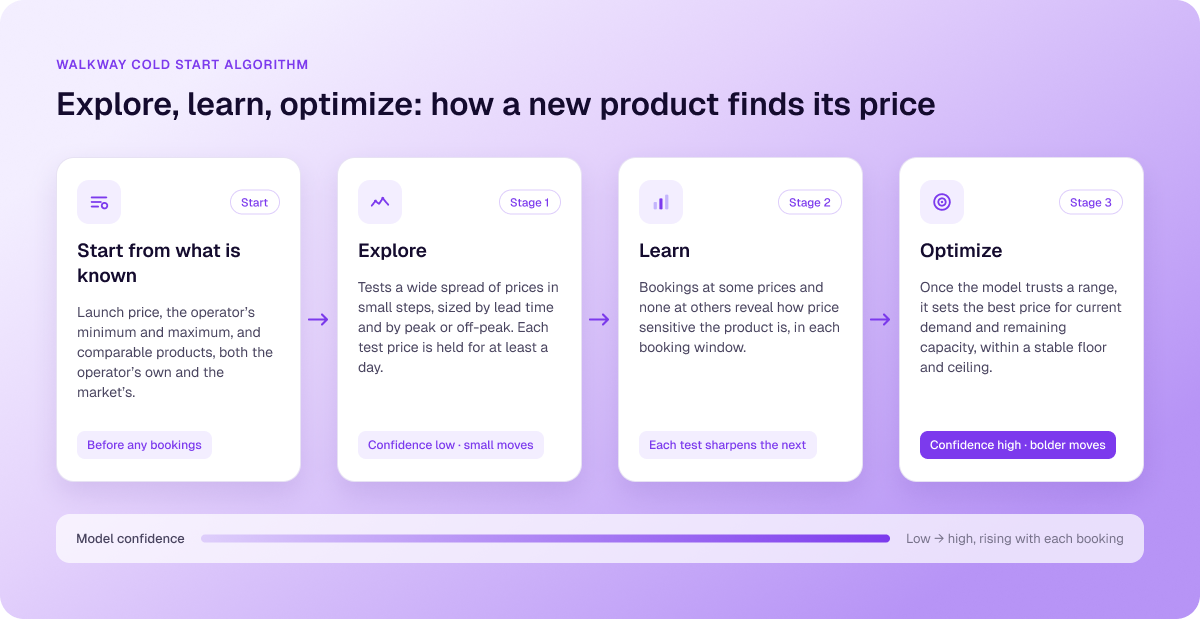
- Start from what is known. Before any bookings arrive, the model starts with the launch price, the operator's minimum and maximum, and comparable products, both the operator's own and the market's.
- Explore. The model tests a wide spread of prices in small steps, sized by lead time and whether the slot is peak or off peak. Each test price is held for at least a day before the next one. Confidence is low, so moves stay small.
- Learn. Bookings at some prices and none at others reveal how price sensitive this product is, in each booking window. Each test makes the next recommendation sharper.
- Optimize. Once the model trusts a range, it stops exploring and sets the best price for current demand and remaining capacity. It can now move more boldly, within a stable floor and ceiling.
Why exploration works for price when randomness hurt ranking
GetYourGuide tested adding randomness to ranking and dropped it because conversion fell. Price exploration is different because it is structured. Steps are small, bounded by the operator's minimum and maximum, and fade as confidence grows. Guardrails keep the output sensible: weekend slots stay above weekday slots where demand supports it, and travelers don't see dozens of different prices for the same day.
Why tours need their own model
Tours vary more than hotel rooms. Walkway prices helicopter tours, walking tours, boat trips and attraction tickets. A hotel has a few room types and hundreds of identical units. Our approach borrows from large retail, where every product is different: the engine reads how each product sells, how fast it fills and how much one booking moves a departure, and adapts how strongly it reacts.
What does a cold start look like in practice?
Imagine a new sunset cruise launching at €42 with no booking history. From the start, Walkway tests different price points across individual departures and demand scenarios, such as quieter weekdays and busier weekends. Each departure can follow its own testing path rather than sharing one price.
Those tests start from the operator’s launch price, minimum and maximum prices, and comparable products in the operator’s portfolio and market. A quieter weekday departure moves from €42 to €38, then to a €34 weekday test that brings in its first bookings. It later tests €36 before returning to €42. A weekend sunset departure tests a different path: €55, then €50, then €52.
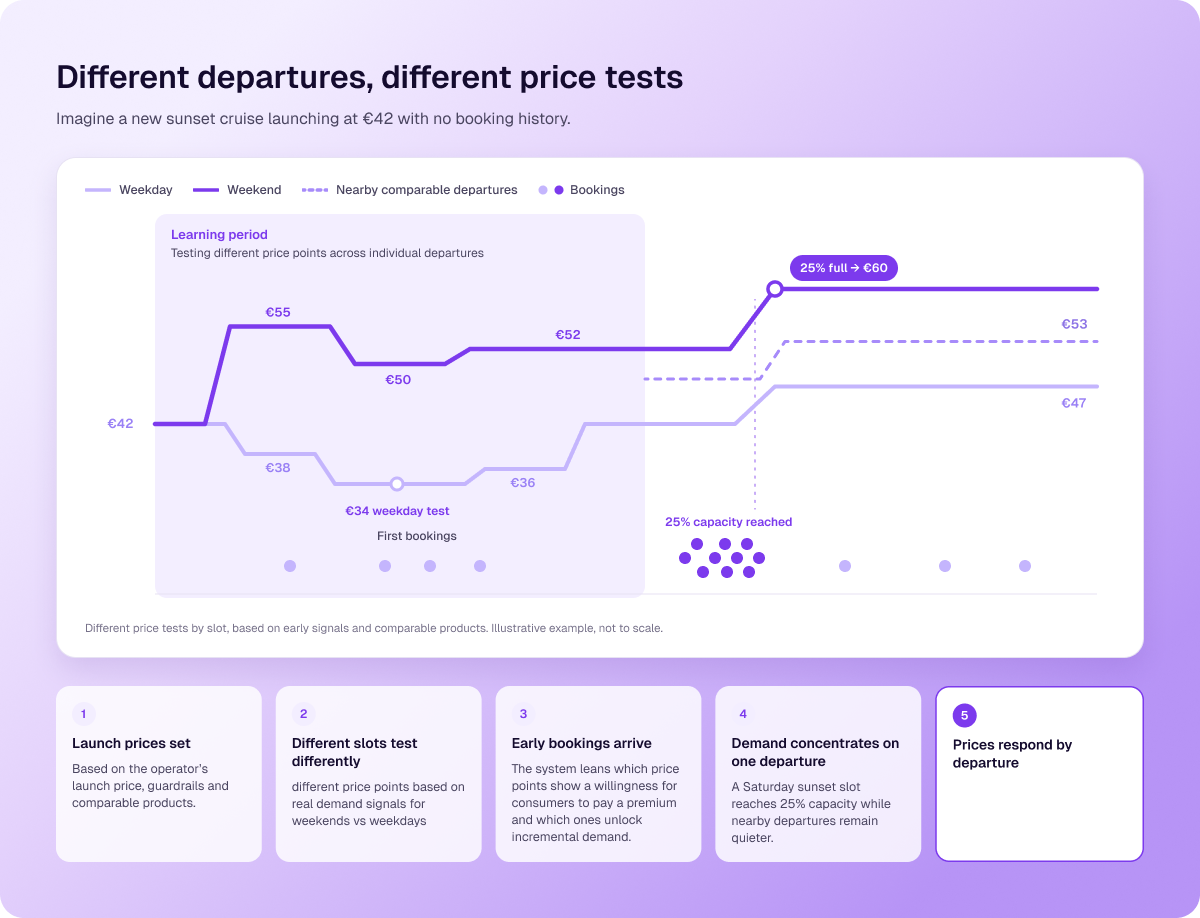
These early bookings help the system learn which price points travelers are willing to pay a premium for, and which lower prices unlock incremental demand. Crucially, Walkway does not treat every booking after a price cut as proof that the cut worked. It measures whether the change in booking pace is likely explained by the lower price, rather than normal demand for that date, slot or lead time.
Then a Saturday sunset departure gets a cluster of bookings and reaches 25% capacity while nearby departures remain quieter. That is a stronger demand signal.
Walkway responds at the departure level: the Saturday sunset price moves from €52 to €60, while nearby comparable departures move more modestly to €53. The weekday departure rises from €42 to €47.
That is the shift from learning to responding. Early on, the system tests a handful of price points to understand where demand begins and whether price is causing the response. Once bookings arrive, it prices according to booking pace, remaining capacity and the way each departure is selling.
How is pricing a new tour different from pricing an established one?
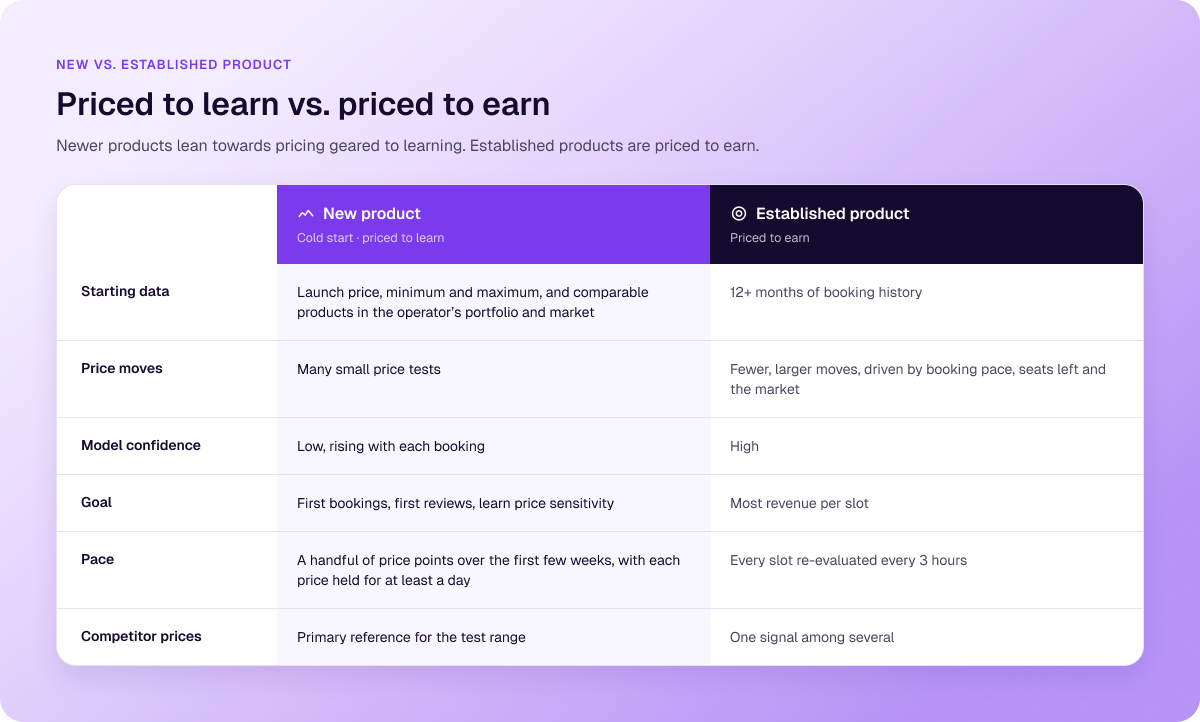
Newer products will lean towards pricing that’s geared towards learning, whereas established products are priced to earn.
| Comparison | New product (cold start) | Established product |
|---|---|---|
| Starting data | Launch price, minimum and maximum, and comparable products in the operator’s portfolio and market | 12+ months of booking history |
| Price moves | Many small price tests | Fewer, larger moves, driven by booking pace, seats left and the market |
| Model confidence | Low, rising with each booking | High |
| Goal | First bookings, first reviews, learn price sensitivity | Most revenue per slot |
| Pace | a handful of price points over the first few weeks, with each price held for at least a day | Every slot re-evaluated every 3 hours |
| Competitor prices | Primary reference for the test range | One signal among several |
How should I price a new tour at launch?
Treat launch pricing as a test, not a decision. Four steps:
- Set a floor and a ceiling. Anchor the floor on your costs and while the ceiling is optional, it can give you peace of mind during early experimentation.
- Price each start time separately. Morning, afternoon and sunset slots can sell differently where demand supports it. Price is one of the few levers that moves demand between slots on the same day.
- Use the OTA boost window. Your first weeks of extra exposure are when price matters most. Aim for the first bookings and reviews before chasing margin.
- Let exploration end. Small tests early, then commit to a range. Prices that keep jumping after the first month confuse travelers and resellers.
The first booking is worth the most
GetYourGuide spent three years learning what Airbnb learned before it: a new product's first weeks decide its lifetime value. Marketplaces solve this with exposure. Operators have to solve it with price, and a new product can't be priced from history it doesn't have yet.
That's what the cold start algorithm is for. Walkway prices new products from their first day on Ventrata, Bokun, Xola, Peek and Prioticket. Launching something new? Book a demo and we'll show you how it would price.
Frequently asked questions
Can dynamic pricing work for a tour with no booking history?
Yes. Walkway's cold start algorithm is built for products with no history. It recommends a price for every slot from day one, then improves as bookings arrive.
How long does it take to find the right price for a new tour?
Most products explore a handful of price points over their first few weeks before settling into a steady range. Products with more traffic learn faster.
Will testing prices hurt my reviews or confuse travelers?
Tests are small and stay inside the minimum and maximum you set. Exploration fades as the model gains confidence, so prices stabilize.
Does the cold start algorithm work with Ventrata, Bokun, Xola, Peek and Prioticket?
Yes. Walkway integrates with all five booking systems and pushes prices to your direct channel and OTAs.
What is the difference between OTA cold start and pricing cold start?
OTA cold start is about exposure: new activities rank low because they have no bookings or reviews. Pricing cold start is about price: there's no booking data to learn price sensitivity from. A new tour faces both at once, so the price it shows during its ranking boost decides whether the boost pays off.